
FDA Releases Cybersecurity Guidance for Aeration & Water Tech Exports
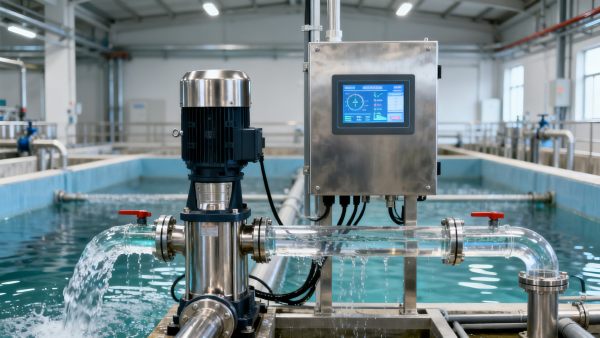
FDA issued new cybersecurity requirements for U.S.-bound smart aeration and water treatment equipment on April 25, 2026 — with direct implications for Chinese exporters serving aquaculture RAS systems, municipal water infrastructure, and industrial wastewater facilities. This marks the first time remote monitoring, OTA firmware updates, and cloud API interfaces are mandatory elements in 510(k) premarket submissions.
Event Overview
On April 25, 2026, the U.S. Food and Drug Administration (FDA) published the Cybersecurity Compliance Guidance for Smart Aeration & Water Treatment Devices (v2.1). The guidance mandates that remote monitoring systems, over-the-air (OTA) firmware upgrade modules, and cloud platform API interfaces be included as required components in 510(k) premarket review submissions. It applies to all devices intended for use in regulated environments — including recirculating aquaculture systems (RAS). Chinese exporting entities must obtain ISO/IEC 27001 certification and submit a NIST SP 800-53 Rev.5 mapping report by December 2026; failure to do so will result in rejection of new device registration applications.
Industries Affected
Direct Exporters of Aeration & Water Treatment Equipment
These companies face immediate regulatory gatekeeping: FDA now treats cybersecurity readiness as a prerequisite for market entry, not a post-approval consideration. Impact manifests in delayed clearance timelines, increased documentation burden, and potential redesign of firmware update mechanisms and API authentication protocols.
Manufacturers Supplying RAS System Components
RAS integrators and subsystem vendors supplying曝气 (aeration) hardware to U.S.-based aquaculture technology firms must align their product architecture with v2.1 requirements — even if they do not file 510(k) directly. Their devices may be classified as 'cybersecurity-relevant components' under FDA’s updated supply chain accountability framework.
Contract Manufacturers & OEMs Supporting U.S.-Branded Devices
OEM partners producing firmware, cloud dashboards, or embedded communication modules for U.S.-registered brands must ensure traceability of security controls across development, testing, and deployment phases — especially where OTA functionality is involved. Lack of documented NIST SP 800-53 Rev.5 alignment may trigger contractual non-compliance risks.
What Enterprises and Practitioners Should Focus On Now
Monitor official FDA communications for implementation clarifications
The guidance references NIST SP 800-53 Rev.5 but does not specify which control families or baselines apply. Companies should track FDA’s upcoming Q&A documents or webinars — expected before Q3 2026 — to confirm whether moderate-impact or high-impact system profiles are assumed.
Prioritize assessment of OTA and API-related architecture
Remote update mechanisms and cloud APIs are newly elevated to mandatory review items. Firms should audit current designs for secure boot, signed firmware validation, session token management, and API rate limiting — as these are likely focal points during FDA technical review.
Distinguish between policy signal and operational deadline
The December 2026 deadline applies only to new 510(k) submissions. Legacy cleared devices are not retroactively subject to v2.1 — unless a significant software change triggers a new submission. Analysis来看, this creates a near-term window for gap remediation without halting existing shipments.
Initiate ISO/IEC 27001 certification planning with documented scope boundaries
Certification must explicitly cover device software development, cloud service integration, and firmware distribution processes. From industry perspective, early engagement with accredited certification bodies familiar with medical device cybersecurity standards (e.g., those also supporting IEC 62304 or UL 2900-2-1) is advisable to avoid scope misalignment.
Editorial Perspective / Industry Observation
This guidance is better understood as a formalization of existing FDA expectations — not a sudden departure. Since 2023, FDA has increasingly cited cybersecurity deficiencies in 510(k) refusal letters for connected environmental health devices. Observation来看, v2.1 codifies what was previously assessed case-by-case into structured, auditable criteria. It signals FDA’s shift toward treating networked water infrastructure devices as ‘cyber-physical medical devices’ — given their role in public health protection. Current more appropriate interpretation is that it reflects regulatory maturation rather than escalation.
Conclusion
The FDA’s updated guidance establishes cybersecurity as a non-negotiable element of market access for smart aeration and water treatment exports — particularly where remote functionality intersects with public health outcomes. It does not impose new technology mandates, but requires demonstrable, standards-aligned governance of digital capabilities already embedded in many products. For affected enterprises, the priority is not wholesale redesign, but targeted documentation, scoping, and process alignment ahead of the December 2026 deadline.
Source Attribution
Main source: U.S. Food and Drug Administration (FDA), Cybersecurity Compliance Guidance for Smart Aeration & Water Treatment Devices (v2.1), issued April 25, 2026.
Points requiring ongoing observation: FDA’s forthcoming interpretation materials on NIST SP 800-53 Rev.5 applicability thresholds and any updates to the Device Cybersecurity Pre-Cert Program scope.
Related Intelligence
- Aeration & Water Tech2M+Hapag-Lloyd to Raise Aeration & Water Tech Special Container Rates from May 2026Aeration & water tech exporters: 2M+Hapag-Lloyd raises OT/FR container rates 18.5% from May 2026 on Asia–Middle East routes — act now to lock in pre-increase freight.
- Aeration & Water TechFDA Releases Cybersecurity Guidance for Aeration & Water Tech ExportsFDA's new cybersecurity guidance for aeration & water tech exports mandates OTA updates, cloud APIs, and ISO 27001 — act now to avoid 510(k) delays!
- Aeration & Water Tech2026 Shanghai Fastener Show Adds Aeration & Water Tech ZoneAeration & Water Tech Zone debuts at 2026 Shanghai Fastener Show—featuring corrosion-resistant fasteners for aquaculture & wastewater systems. Discover engineered, smart connection solutions.
The Morning Broadsheet
Daily chemical briefings, market shifts, and peer-reviewed summaries delivered to your terminal.
