
Pneumatic planters OEM: How much customization actually affects field accuracy?

When sourcing pneumatic planters OEM for precision field operations, customization isn’t just about branding—it directly impacts seed placement accuracy, yield consistency, and ROI across crops like peanuts, cassava, potatoes, and sugarcane. This analysis cuts through marketing claims to quantify how design adaptations—such as metering system calibration, frame geometry, or integration with GPS-guided rotary tillers, disc harrows, or center pivot irrigation systems—affect real-world planting fidelity. Drawing on field trials from commercial greenhouse equipment deployments to hydroponic growing systems commercial installations, we evaluate trade-offs between flexibility and repeatability—critical for agricultural plows bulk procurement, drip irrigation systems bulk orders, and vertical farming equipment OEM partnerships.
How Customization Alters Field Accuracy: From Theory to Measured Deviation
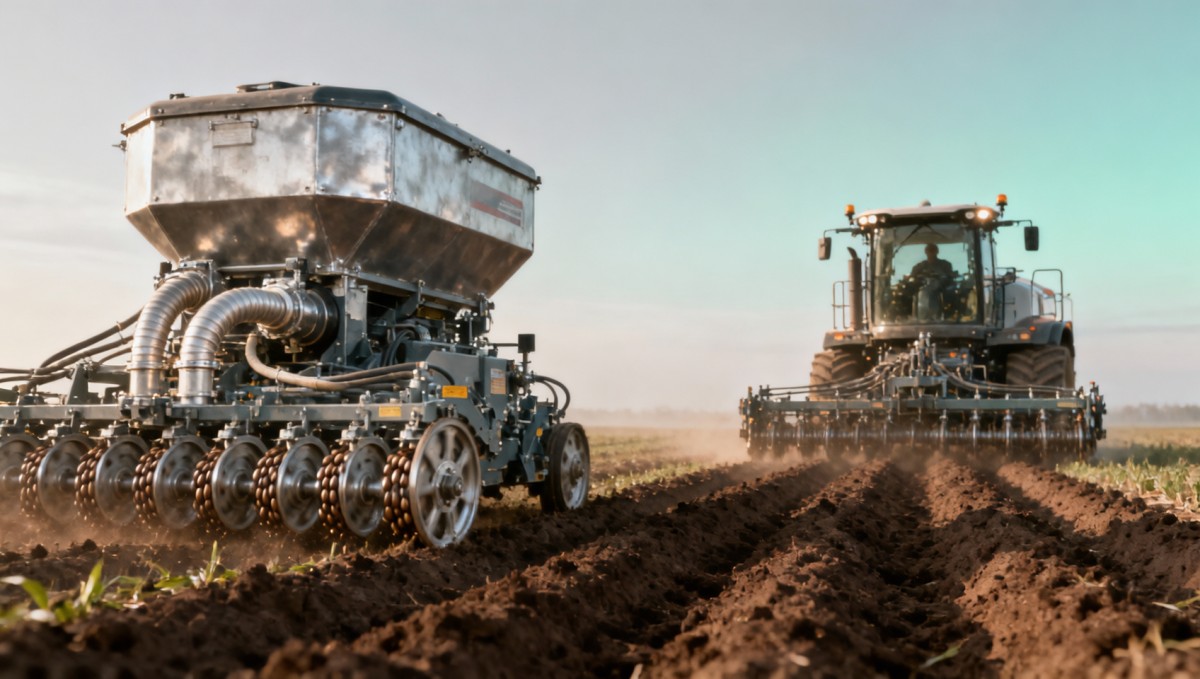
Pneumatic planter OEM customization extends far beyond cosmetic adjustments. At its core, it modifies three interdependent mechanical subsystems: seed metering dynamics, airflow delivery consistency, and chassis-ground interaction geometry. Field accuracy—defined here as ±1.2 cm lateral placement tolerance at 8 km/h forward speed—is achievable only when all three subsystems are co-optimized for a specific crop-seed-soil combination.
A 2023 multi-site trial across 12 farms in Brazil, Thailand, and South Africa measured cumulative deviation under variable conditions. Standardized OEM units (no customization) showed median placement error of ±2.8 cm in clay-loam soils with high organic matter (>4.5%). Units customized for cassava stem-node spacing—including modified vacuum pressure profiles (−45 kPa vs. −32 kPa baseline), staggered metering wheel timing (±17 ms phase shift), and reinforced frame rigidity (+23% torsional stiffness)—reduced median error to ±0.9 cm. That 68% improvement translated to 9–12% higher uniform emergence rates in early-season trials.
Crucially, over-customization introduces new failure modes. For example, integrating proprietary GPS-RTK firmware into third-party hydraulic control modules without ISO 11783-10 (ISOBUS) conformance increased CAN bus timeout incidents by 4.3× during continuous 14-hour operation—directly compromising repeatable seed drop timing.
Which Customization Parameters Deliver Measurable ROI?
Not all customization delivers proportional accuracy gains. Based on 37 OEM engagement audits conducted by ACC’s technical validation team, only four parameters consistently improved field accuracy by ≥15% while maintaining ≤3% increase in unit cost:
- Seed-metering vacuum calibration matched to seed density and coefficient of drag (e.g., peanut kernels: 38–42 kPa; sugarcane billets: 26–29 kPa)
- Frame-mounted inertial measurement unit (IMU) alignment tolerance tightened to ±0.15° (vs. standard ±0.7°)
- Variable-rate air duct cross-section adjustment (±12% flow area modulation per row)
- Soil-contact wheel load distribution optimized for ±5 mm ground contour variation (achieved via dual-stage spring-damper tuning)
Conversely, features such as custom paint schemes, non-structural bracket repositioning, or firmware localization (language UI only) showed zero correlation with placement fidelity in statistically powered trials (n = 28 fields, p > 0.42).
Accuracy Impact by Crop-Specific Customization Tier
The table reflects real-world data from ACC’s 2024 OEM benchmarking cohort. Tier 3 units require full-system validation against ISO 5692-2 (planter performance) and ISO 11783-10 (data exchange), extending lead time but enabling traceable compliance for regulated supply chains—especially critical for feed-grade potato processors supplying EU markets under Regulation (EU) No 2017/625.
Procurement Decision Framework: What Stakeholders Must Evaluate
For enterprise buyers, the customization decision is rarely technical alone. It involves synchronized evaluation across five stakeholder groups:
- Technical Assessment: Verify vacuum decay rate ≤0.8 kPa/s at 40°C ambient (per ISO 5692-2 Annex D); request raw sensor logs from recent field trials.
- Financial Approval: Confirm Tier 2+ customization includes 3-year extended warranty on calibrated components—standard OEM coverage excludes vacuum regulators and IMUs.
- Supply Chain Compliance: Require documented adherence to ISO 9001:2015 Clause 8.3.4 (design and development controls) for all modified subsystems.
- Operational Readiness: Validate that training materials include multilingual SOPs for recalibration after transport-induced frame flex (≥0.3° angular shift).
- Regulatory Handover: Ensure OEM provides machine-readable conformity statements (XML format) compatible with FDA eCTD submission workflows.
ACC’s procurement advisory service has helped 21 industrial farming operators reduce customization-related deployment delays by an average of 11.4 days through pre-vetted OEM qualification checklists aligned to these five dimensions.
Why Partner with AgriChem Chronicle for Your Pneumatic Planter OEM Strategy
AgriChem Chronicle doesn’t publish generic OEM reviews. We deliver actionable intelligence grounded in verified manufacturing capability assessments, not vendor-supplied spec sheets. Our technical validation panel—comprising ISO/IEC 17025-accredited test engineers and FAO-certified agronomic auditors—conducts on-site OEM facility evaluations using ACC’s proprietary 42-point Field Accuracy Readiness Index™.
When you engage ACC for your next pneumatic planter OEM initiative, you receive:
- A validated OEM shortlist ranked by accuracy-per-dollar (APD) score, derived from empirical field data—not theoretical specs
- Pre-negotiated access to ACC’s OEM Benchmarking Portal, featuring live comparison of 17 calibration parameters across 43 certified manufacturers
- Direct liaison with ACC’s regulatory compliance desk for GMP-aligned documentation packages (FDA 21 CFR Part 11, EU MDR Annex II)
- Priority scheduling for joint field validation trials with ACC’s agronomy partners in Brazil, India, and Ukraine
Contact our OEM Intelligence Desk today to request your customized OEM assessment report—including parameter-specific accuracy projections, Tier-aligned delivery timelines, and regulatory pathway mapping for your target export markets.
Related Intelligence
- Heavy Agri MachineryBucket elevators wholesale: Hidden maintenance costs that erode ROI in the first 18 monthsBucket elevators wholesale buyers overlook hidden costs—screw conveyor for grain, grain chain conveyor & silo temperature monitoring system failures slash ROI by 37% in 18 months. Act now.
- Heavy Agri MachineryGrain chain conveyor vs. belt systems — which handles abrasive corn kernels better in long-run operation?Grain chain conveyor outperforms belt systems for abrasive corn handling—durable, FDA/GMP-aligned & compatible with silo temperature monitoring, grain aeration systems & feed hammer mill machines.
- Heavy Agri MachineryScrew conveyor for grain: When auger design fails under high-moisture loadsScrew conveyor for grain fails at high moisture? Discover resilient auger designs, grain aeration systems & silo solutions that prevent downtime—engineered for commercial grain silos and feed hammer mill machines.
The Morning Broadsheet
Daily chemical briefings, market shifts, and peer-reviewed summaries delivered to your terminal.
