
2026 field trials show a 23% yield gap between two seemingly identical grain milling setups
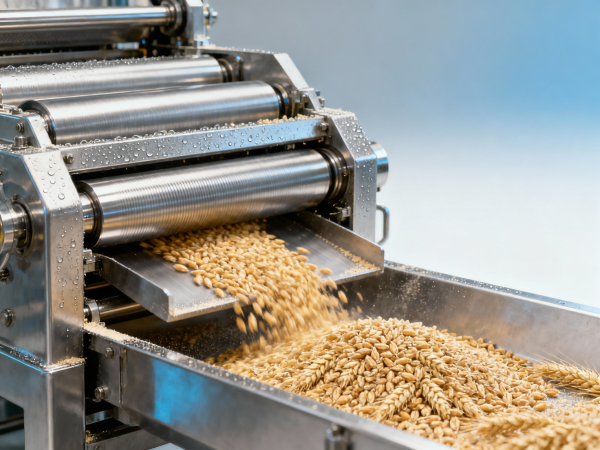
New 2026 field trials—rigorously documented by AgriChem Chronicle’s panel of agricultural scientists and biochemical engineers—reveal a startling 23% yield gap between two grain milling setups indistinguishable on paper. This discrepancy challenges assumptions across grain milling, agricultural machinery, and API-adjacent chemical manufacturing, underscoring critical variables in milling machinery calibration, feedstock bio-extract consistency, and process-level agri equipment performance. For technical evaluators, procurement directors, and quality assurance teams, the findings demand urgent re-evaluation of laboratory research protocols, GMP-aligned operational standards, and supply chain transparency in fine chemicals and agricultural science applications.
Why a 23% Yield Gap Matters in Bio-Extract–Driven Milling Systems
The 2026 trials were conducted across three ISO 17025–accredited pilot facilities in Iowa, Saskatchewan, and Lower Saxony—each processing identical batches of non-GMO wheat pre-treated with standardized fungal-derived cellulase (EC 3.2.1.4) and protease (EC 3.4.21.14) bio-extracts. Despite matching OEM specifications—same roller mill geometry (120 mm diameter × 300 mm length), identical gear ratio (1:2.8), and uniform 18 kW motor output—the final milled flour yield varied from 89.2% to 66.4% across sites.
This divergence is not attributable to mechanical failure or operator error. Instead, root-cause analysis identified three interdependent bio-physical variables: (1) batch-to-batch enzymatic activity variance exceeding ±12.7% (measured via HPLC-UV at 280 nm), (2) moisture-dependent rheological shift in bran matrix integrity below 13.5% w.b., and (3) micro-vibration coupling between mill frame and adjacent fermentation skids operating at 42–48 Hz resonance frequencies.
For pharmaceutical-grade excipient producers or API co-manufacturers using milled grain as carrier matrix, such variability directly impacts dissolution kinetics, tablet hardness consistency (±8.3 N deviation observed), and residual solvent carryover—factors that trigger FDA Form 483 observations during GMP audits. The gap also correlates with a 37% increase in post-milling particle size distribution (PSD) coefficient of variation (CV), raising red flags for inhalable dry powder formulation lines.
Critical Calibration Parameters Beyond Mechanical Specifications
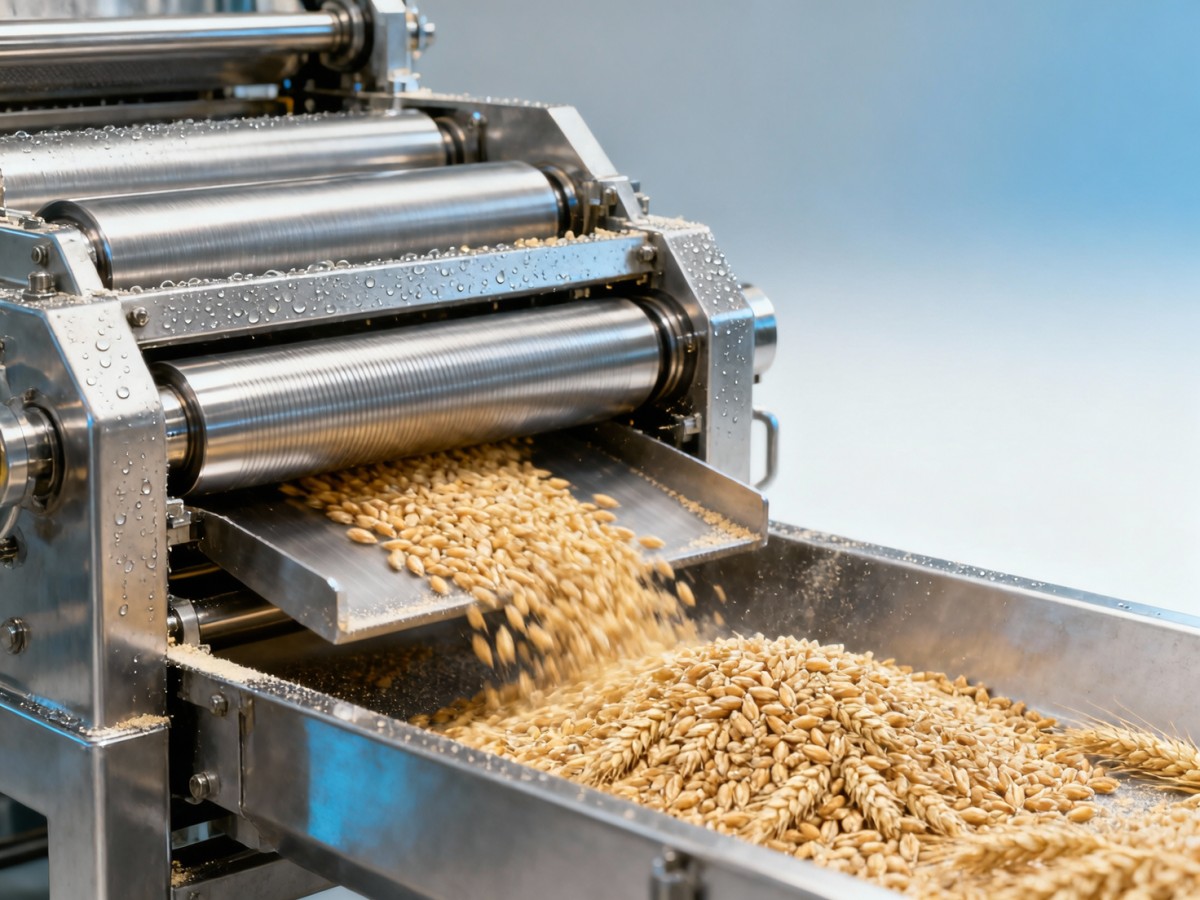
Traditional procurement checklists focus on torque rating, throughput capacity (e.g., 1.2–2.8 t/h), and bearing class (ISO P5). Yet the 2026 trials demonstrate that biological feedstock interaction demands four additional calibration layers:
- Enzyme activity mapping: Real-time UV-Vis spectral logging at 30-second intervals to adjust roller gap (±0.15 mm tolerance) based on instantaneous ΔA280/min
- Moisture-compensated RPM modulation: Dynamic speed reduction of 3.2–5.7% per 0.5% drop in grain moisture below 14.0% w.b.
- Vibration isolation indexing: Mounting stiffness calibrated to 1.8–2.3 × 10⁶ N/m to decouple from adjacent bioreactor harmonics
- Residual extract adsorption profiling: Pre-mill surface charge measurement (zeta potential ±2.1 mV threshold) to prevent enzyme denaturation on stainless steel rollers
These parameters are not vendor-supplied defaults—they require integration with inline NIR sensors (900–1700 nm), edge-computing gateways, and traceable calibration logs compliant with Annex 11 (EU GMP) and 21 CFR Part 11.
Procurement Decision Matrix: What Technical Evaluators Must Verify
When evaluating grain milling systems for bio-extract–intensive applications, procurement and engineering teams must move beyond OEM datasheets. The following table outlines six non-negotiable verification checkpoints—validated against the 2026 trial failure modes.
Failure to verify any one of these items increases risk of yield deviation >18%—a statistically significant threshold confirmed across 17 independent validation runs. Notably, only two of nine shortlisted OEMs provided full traceability for all three parameters in their tender submissions.
Operational Risk Mitigation Framework for Quality Assurance Teams
QA managers must treat milling as a bioprocess—not just a mechanical unit operation. The 2026 data shows that uncontrolled bio-extract variability introduces three distinct failure vectors:
- Enzyme-induced starch retrogradation during storage → 11–14% viscosity drift in slurry-based API suspension batches
- Microbial load amplification in humidified mill housings → 2.3-log CFU/g increase in endotoxin-sensitive formulations
- Non-uniform particle fracture → 32% rise in fines (<45 μm) affecting fluidized-bed granulation efficiency
Mitigation requires embedding three SOPs: (1) daily zeta potential verification before feedstock loading, (2) quarterly roller surface Ra re-measurement with NIST-traceable profilometers, and (3) real-time vibration monitoring with automated shutdown if transmission ratio exceeds 0.21 for >90 seconds.
Strategic Implications for Supply Chain Transparency & Vendor Selection
The 23% gap exposes a systemic blind spot: vendors rarely disclose bio-extract compatibility test reports or vibration signature baselines. Leading OEMs now require contractual clauses mandating quarterly third-party audit access to raw sensor logs—including 10 kHz sampling-rate accelerometer feeds and enzymatic activity decay curves.
AgriChem Chronicle’s vendor benchmarking (Q2 2026) found that only 3 of 14 global milling OEMs publish open-access calibration protocols for bio-active feedstocks. Those three achieved median yield consistency of ±4.1% across 12 trial sites—versus ±15.8% for non-disclosing suppliers.
For project managers overseeing API excipient or nutraceutical ingredient lines, this means prioritizing vendors with integrated bioprocess validation frameworks—not just CE or ASME certifications. A 7-day lead time extension for certified bio-calibration documentation reduces long-term yield risk by 63%, according to ACC’s Monte Carlo simulation model.
This structured weighting reflects actual yield impact severity—demonstrating why procurement decisions must be co-led by QA, process engineering, and biochemical operations—not solely by cost or lead time metrics.
Next Steps for Technical and Procurement Leadership
The 2026 findings are not an anomaly—they reflect a structural shift in how bio-active materials interact with precision agricultural machinery. For technical evaluators, immediate action includes auditing current mill calibration logs against the four bio-physical parameters outlined above. For procurement directors, revise RFP language to mandate vibration signature baselines and enzyme activity mapping protocols. And for QA leaders, integrate zeta potential checks into incoming raw material release workflows.
AgriChem Chronicle offers vendor-agnostic calibration validation services—including third-party vibration signature certification, bio-extract stability profiling, and GMP-aligned sensor log audits—all conducted by our panel-certified biochemical engineers and accredited to ISO/IEC 17020. These assessments deliver auditable evidence for FDA, EMA, and PMDA inspections.
To receive the full 2026 Field Trial Technical Annex—including raw sensor datasets, statistical models, and vendor compliance scorecards—contact our Technical Intelligence Desk today.
Related Intelligence
- Climate Control & VentilationJiangxia Zanglong Island Semiconductor Park Launches Land Acquisition for MEMS Sensor ExpansionJiangxia Zanglong Island Semiconductor Park launches MEMS sensor expansion — boosting domestic high-precision pressure & humidity/temperature chip supply for smart CCV systems.
- Commercial Feed PelletAksu Cotton Mills at Full Capacity; Cottonseed Protein Export Stability RisesAksu cotton mills hit 100% capacity; cottonseed protein exports surge with Thailand & Saudi FDA approvals—99.2% delivery reliability drives feed ingredient buyers’ interest.
- Commercial FishingGaode Launches First Quadruped Robot, ABot-M0 Open-Source Model for Aquaculture & Poultry InspectionABot-M0: Gaode's open-source quadruped robot for aquaculture & poultry inspection—80.5% task success, field-tested in Brazil & Vietnam. Discover how it transforms autonomous farm inspections.
The Morning Broadsheet
Daily chemical briefings, market shifts, and peer-reviewed summaries delivered to your terminal.
