
SASO Replaces Poultry Housing Certification with ESMA Halal-Industrial Standard
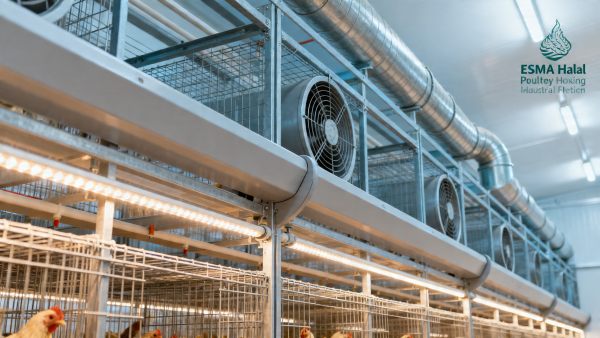
Saudi Arabia’s Standards, Metrology and Quality Organization (SASO) has updated its mandatory certification requirement for poultry housing and caging equipment, effective 1 July 2026. The change directly impacts exporters, manufacturers, and supply chain operators serving the Saudi agricultural infrastructure market — particularly those engaged in livestock facility design, metal fabrication, ventilation systems, and halal-compliant operations.
Event Overview
On 18 April 2026, SASO jointly announced with the Saudi Authority for Industrial Regulation (ESMA) that, starting 1 July 2026, all imported poultry housing and caging equipment must hold the ESMA Halal-Industrial certification. The previous SASO 2502 standard is formally discontinued. The new certification introduces mandatory animal welfare design review criteria — including ventilation redundancy rate, light spectrum specifications, and stress-buffering structural features — as well as a compulsory Halal Operations Manual for facility management.
Which Subsectors Are Affected
Direct Exporters & Trading Companies
Exporters shipping poultry cages, broiler houses, or automated layer systems to Saudi Arabia will no longer be able to rely on SASO 2502 compliance documentation. Their shipments post-1 July 2026 will require full ESMA Halal-Industrial certification — including third-party verification of both product design and operational guidance documents. This affects customs clearance timelines, pre-shipment testing scope, and contract terms tied to certification validity.
Manufacturers & Equipment Integrators
Manufacturers — especially those producing modular poultry housing, cage frames, climate control units, or lighting systems — must now incorporate animal welfare parameters into engineering specifications. Ventilation redundancy (e.g., backup airflow capacity ≥30%), tunable LED spectral output (with documented photobiological safety), and passive stress-mitigation features (e.g., rounded corners, non-reflective surfaces, vibration-dampening mounts) are now design prerequisites — not optional enhancements.
Supply Chain & Certification Support Providers
Third-party certification bodies, testing laboratories, and technical consultants assisting clients with SASO compliance must update their service portfolios to reflect ESMA’s new framework. This includes capability to assess Halal-aligned maintenance protocols, verify documentation alignment between physical hardware and the required Halal Operations Manual, and support audits covering both factory production and end-user implementation readiness.
What Relevant Businesses or Practitioners Should Focus On Now
Monitor official ESMA guidance updates before mid-June 2026
The initial announcement confirms the transition date and scope but does not yet publish full technical annexes — including test methods for ventilation redundancy verification or acceptable light spectrum bands. Current more appropriate action is to track ESMA’s official portal for release of Implementation Guidelines and Recognized Testing Laboratories lists.
Prioritize review of high-volume SKUs and legacy designs
Companies should identify which poultry housing models or cage configurations currently certified under SASO 2502 account for >70% of their Saudi-bound exports. These items require immediate re-evaluation against the new design and documentation requirements — especially where ventilation architecture or lighting integration is proprietary or non-modular.
Distinguish between certification eligibility and operational readiness
ESMA Halal-Industrial certification covers both product conformity and facility-level operational compliance. Suppliers must prepare not only for product testing but also for supporting buyers’ internal Halal Operations Manual development — meaning technical documentation must extend beyond CE/ISO-type declarations to include maintenance schedules, cleaning agent approvals, and staff training references aligned with Islamic principles of animal treatment.
Initiate supplier coordination for component-level documentation
Since ventilation fans, LED drivers, and structural fasteners may influence compliance outcomes (e.g., through electromagnetic interference affecting light spectrum stability or corrosion resistance impacting long-term structural integrity), original equipment manufacturers should engage Tier-2 suppliers now to secure material declarations, durability test reports, and compatibility statements needed for full-system certification.
Editorial Perspective / Industry Observation
From industry perspective, this shift reflects a broader institutional move toward integrating religiously grounded operational standards into industrial technical regulation — not merely as a labeling or market access condition, but as a functional design driver. Analysis来看, the inclusion of ventilation redundancy and light spectrum controls signals an intent to elevate baseline welfare performance beyond minimum regulatory thresholds. Observation来看, ESMA’s assumption of certification authority from SASO suggests a consolidation of halal-related industrial oversight under a single agency — potentially streamlining future halal-integrated standards across food processing, pharmaceuticals, and agri-infrastructure. Current more appropriate understanding is that this is a policy signal with immediate procedural consequences: it is not a pilot or voluntary phase-in, but a hard deadline with enforceable import controls.
This update marks a structural recalibration in how technical compliance intersects with ethical and religious frameworks in Saudi industrial regulation. It is neither a temporary adjustment nor a narrow product-category revision — rather, it establishes a precedent for welfare-by-design mandates anchored in halal governance. For stakeholders, the practical implication is clear: certification is no longer solely about dimensional accuracy or material composition; it now encompasses environmental physiology, behavioral science inputs, and operational theology — all codified into verifiable technical criteria.
Information Source: Official joint notice issued by SASO and ESMA on 18 April 2026. Ongoing monitoring is advised for ESMA’s forthcoming Technical Implementation Guide and list of accredited testing laboratories — both remain pending as of publication date.
Related Intelligence
- Poultry Housing & CagingSASO Replaces Poultry Housing Certification with ESMA Halal-Industrial StandardSASO replaces poultry housing certification with ESMA Halal-Industrial standard—key for exporters, manufacturers & certifiers targeting Saudi agri-infrastructure.
- Poultry Housing & CagingESMA Launches Halal-Industrial Certification for Poultry Housing & CagingHalal-Industrial certification now covers poultry housing & caging — ESMA’s groundbreaking 2026 standard for GCC exporters, manufacturers, and suppliers.
- Poultry Housing & Caging2026 Food Expo Sets Up 99 Rural Support Zones, Features Guizhou Tianzhu Eggs for Greater Bay Area2026 Food Expo highlights 99 rural support zones, featuring Guizhou Tianzhu's antibiotic-free eggs with Hong Kong supply qualifications. Connect with certified Chinese egg product suppliers for streamlined sourcing.
The Morning Broadsheet
Daily chemical briefings, market shifts, and peer-reviewed summaries delivered to your terminal.
