
The Authority in Global Agricultural Chemistry & Bio-Resources
Chiral intermediates wholesale: when lower price leads to harder scale-up
In chiral intermediates wholesale, the lowest quote can hide the highest downstream cost. For enterprise decision-makers, an attractive unit price often turns into delayed validation, unstable batches, regulatory setbacks, and expensive scale-up failures. Understanding where price-driven sourcing breaks down is essential for protecting timelines, quality consistency, and long-term manufacturing resilience.
Why does the cheapest chiral intermediates wholesale offer so often create bigger problems later?
At first glance, chiral intermediates wholesale looks like a straightforward procurement category: compare specifications, compare price per kilogram, then choose the most competitive supplier. In reality, the economics are far more complex. A chiral intermediate is not just a raw material; it is a control point that influences stereochemical purity, impurity profile, downstream process reproducibility, and final regulatory acceptability. When the price is unusually low, it often signals compromises that may not be visible in the first quotation.
The most common hidden weaknesses include inconsistent enantiomeric excess, loosely defined impurity limits, incomplete analytical packages, poor process robustness, and limited ability to reproduce the same material at larger batch sizes. A vendor may be able to deliver a small pilot quantity that passes a basic incoming quality check, yet fail when the buyer requests larger lots, tighter release criteria, or long-term supply continuity. That is where low entry pricing becomes a high total cost event.
For decision-makers in fine chemicals, APIs, agrochemical synthesis, and advanced ingredient production, the real question is not “Who offers the lowest price?” but “Who can protect validation timelines and commercial reliability?” In chiral intermediates wholesale, the cost of a failed batch, delayed clinical or product launch milestone, or regulatory deviation usually outweighs any apparent savings on unit price.
What exactly should buyers verify before approving a chiral intermediates wholesale supplier?
A practical supplier review should go beyond a certificate of analysis. Enterprise procurement teams should align technical, quality, manufacturing, and compliance functions before awarding volume. The first checkpoint is whether the supplier truly controls the synthesis route rather than merely trading material from a secondary source. Traders can be useful in some categories, but for chiral intermediates wholesale, lack of route control usually means weak batch-to-batch consistency and poor change notification discipline.
The second checkpoint is analytical depth. Buyers should request method details for chiral purity, residual solvents, related substances, water content, and critical residual reagents or catalysts. If the supplier cannot explain how stereochemical integrity is measured and maintained, scale-up risk rises immediately. It is also important to understand whether the reported values reflect routine commercial manufacturing or hand-selected laboratory batches prepared for qualification.
Third, ask for evidence of scale history. A supplier that has only produced kilogram-level material may not be ready for 100-kilogram or ton-scale demand. Reaction exotherms, crystallization behavior, solvent recovery, filtration time, and chiral resolution efficiency can all change significantly with scale. Strong vendors can explain which parameters become more difficult during expansion and what controls they use to stabilize output.
Finally, verify the quality system and documentation culture. In sectors influenced by GMP, FDA expectations, environmental rules, or export compliance, documentation gaps can become commercial barriers. Even outside pharmaceutical end use, enterprise customers increasingly expect traceability, deviation handling, and change management. Reliable chiral intermediates wholesale partners understand that documentation is part of the product.
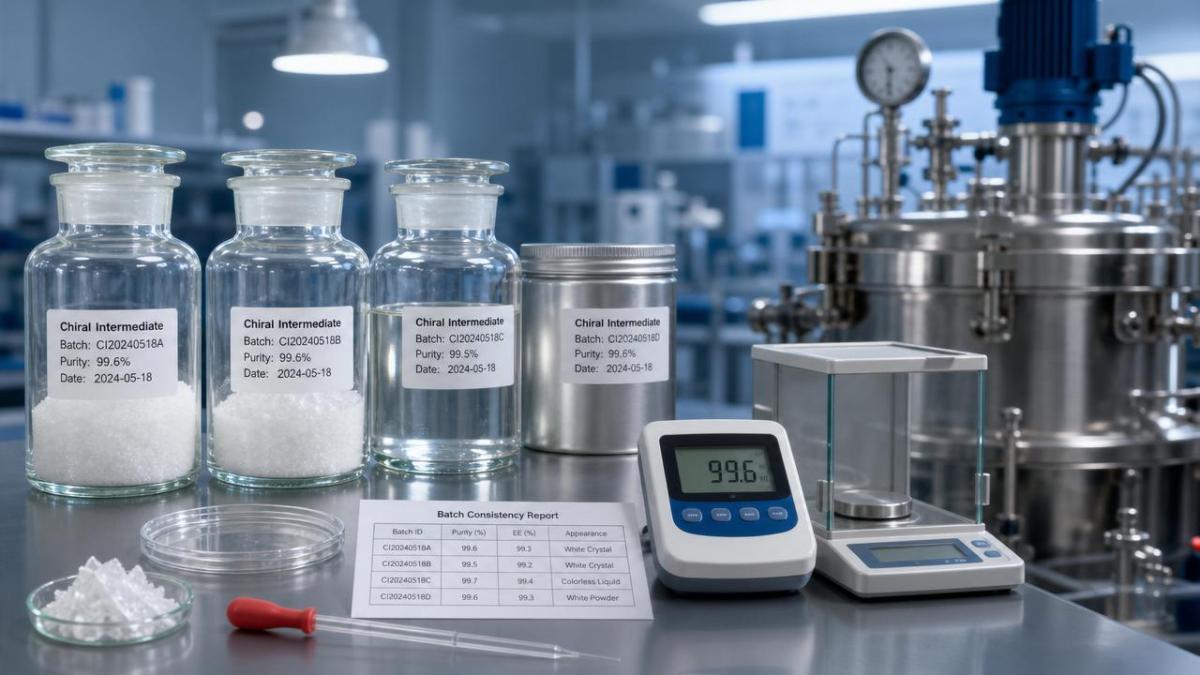
How can a lower quote undermine scale-up, even when the sample quality initially looks acceptable?
This is one of the most misunderstood issues in chiral intermediates wholesale. A sample that performs well in a small trial does not guarantee manufacturability at larger scale. Low-cost suppliers sometimes optimize for quotation speed and sample conversion, not for robust commercial production. That creates a mismatch between early qualification success and later supply failure.
Several scale-up failure patterns appear repeatedly. One is raw material substitution without formal notification. A supplier may change a starting material grade, solvent source, or catalyst vendor to preserve margin under a low-price contract. The resulting material may still meet headline specifications, yet introduce impurity drift that affects downstream reactions or purification yield. Another pattern is process variability hidden by broad internal acceptance limits. If a vendor operates with wide in-process variation, larger campaigns can magnify that instability.
There is also the issue of capacity illusion. Some suppliers quote aggressively to win strategic accounts, but rely on shared reactors, outsourced steps, or limited utility support. Once orders increase, lead times stretch, scheduling conflicts emerge, and consistency suffers. In chiral chemistry, especially where asymmetric synthesis or chiral resolution is involved, these operational weaknesses quickly become technical failures.
Enterprise buyers should therefore test not only the product but the production system behind it. Process capability, plant fit, analytical rigor, and supply chain transparency are all part of scale-up readiness. Price alone tells almost nothing about those factors.
Which warning signs in chiral intermediates wholesale usually predict future cost escalation?
The following table summarizes common warning signs that procurement and technical teams should treat seriously. In many cases, these signals appear before any major quality event occurs.
These signals do not automatically disqualify a supplier, but they should trigger a more rigorous review. In chiral intermediates wholesale, cost escalation often begins with assumptions that were never tested early enough.
Who is most exposed to low-price sourcing risk in chiral intermediates wholesale?
The exposure is highest for companies operating under tight validation windows, regulated end markets, or process-sensitive synthesis pathways. Pharmaceutical and biotech manufacturers are obvious examples because a single change in chiral impurity behavior can affect method validation, impurity qualification, and filing consistency. However, the risk is not limited to drug manufacturing.
Agrochemical producers, specialty ingredient manufacturers, and high-value fine chemical companies can be equally vulnerable. Many of these businesses run integrated production campaigns where one intermediate disruption stops an entire sequence. If a low-cost source fails, the loss is not just material replacement cost; it includes idle production time, rescheduling, extra quality investigations, and customer delivery penalties.
Decision-makers should be especially cautious when the intermediate influences yield-critical, stereoselective, or purification-heavy downstream steps. In those scenarios, slight variation in one incoming chiral intermediate can multiply cost across the full process. Chiral intermediates wholesale therefore deserves strategic treatment, not routine commodity sourcing logic.
How should enterprise buyers compare suppliers beyond price?
A better approach is to compare total commercial fitness, not just quoted cost. Leading procurement teams often use a weighted scorecard that includes technical reproducibility, scale record, quality documentation, responsiveness, audit openness, and continuity planning. This creates a decision framework that reflects the true economics of supply.
One effective method is to evaluate suppliers across four practical dimensions. First is chemistry control: route ownership, critical parameter management, and impurity understanding. Second is manufacturing reliability: batch size history, equipment suitability, and utility capacity. Third is compliance readiness: documentation quality, traceability, and change-control behavior. Fourth is commercial resilience: lead-time realism, backup planning, and communication discipline.
When chiral intermediates wholesale is assessed this way, the “best-value” supplier is often not the cheapest on paper. Instead, it is the partner with the lowest probability of causing costly surprises. That distinction matters for enterprise leaders who are accountable for forecast accuracy, launch timelines, and operational risk.
What are the most common misconceptions about reducing cost in chiral intermediates wholesale?
A major misconception is that tighter negotiation alone creates sustainable savings. In reality, forcing price down without aligning on process capability often transfers hidden cost into quality failures or unstable supply. Another misconception is that passing initial QC means the sourcing decision is safe. Initial conformity only proves a narrow point in time; it does not confirm process robustness across multiple batches and scales.
Some buyers also assume that broad specification ranges create flexibility. While flexibility can help in early-stage development, unclear acceptance standards frequently create disputes later. For chiral intermediates wholesale, poorly defined stereochemical and impurity expectations make investigations slower and accountability weaker. It is usually better to agree early on what “commercially acceptable consistency” really means.
Finally, many organizations underestimate the value of supplier transparency. A vendor that openly discusses process limits, yield tradeoffs, and scale-up constraints may actually be the safer commercial choice than a low-cost supplier that promises everything with little data. Transparency does not eliminate risk, but it makes risk manageable.
What should be discussed first before moving forward with procurement, validation, or cooperation?
Before committing to a chiral intermediates wholesale program, enterprise teams should align around a short list of critical questions. Ask what batch sizes have already been manufactured and released. Ask whether the synthesis route, key raw materials, and analytical methods are fixed or still evolving. Ask what change-control commitments the supplier will provide. Ask how they manage deviations, reprocessing, and out-of-specification events. Ask whether they can support audit requests, technical data review, and long-term capacity planning.
It is also wise to confirm practical commercial points early: realistic lead times, safety stock assumptions, packaging standards, shipping conditions, and backup manufacturing options. For strategic materials, dual-sourcing logic or phased qualification may be more economical than relying on a single low-price source. The goal is not to eliminate every uncertainty, but to make risk visible before it becomes expensive.
In chiral intermediates wholesale, the most effective buyers are the ones who evaluate price in context. If the next step is to confirm a specific sourcing plan, technical package, timeline, quotation structure, or cooperation model, the most useful starting conversation is not “Can you be cheaper?” but “Can you demonstrate repeatable quality, transparent control, and scalable supply?” That question protects both procurement efficiency and long-term manufacturing success.
Related Intelligence
- APIs & IntermediatesActive pharmaceutical ingredients OEM: where quality drift can startActive pharmaceutical ingredients OEM buyers: discover where quality drift starts, from process controls to supplier oversight, and use this practical checklist to reduce compliance and supply risk.
- APIs & IntermediatesWholesale excipients: how to judge consistency beyond COA dataWholesale excipients sourcing goes beyond a clean COA. Learn how to assess batch consistency, impurity trends, change control, and supplier transparency to reduce quality and compliance risk.
- APIs & IntermediatesChiral intermediates wholesale: when lower price leads to harder scale-upChiral intermediates wholesale is not just about the lowest quote. Learn how to avoid hidden scale-up risk, batch inconsistency, and costly delays before choosing a supplier.
The Morning Broadsheet
Daily chemical briefings, market shifts, and peer-reviewed summaries delivered to your terminal.
