
Rice milling machines wholesale buyers often misread ‘capacity’—real throughput vs. nameplate rating
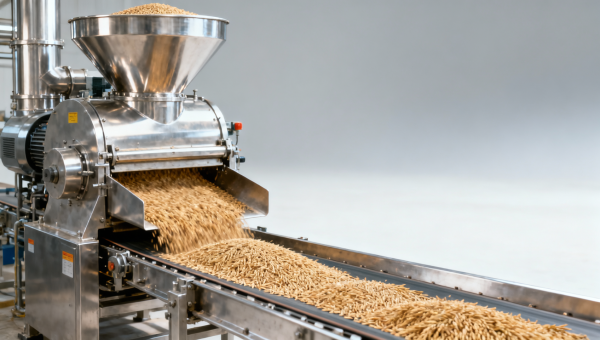
Wholesale buyers of rice milling machines frequently confuse nameplate capacity with real-world throughput—leading to costly underperformance in parboiled rice mill plants, commercial flour mill machinery, and integrated grain processing lines. This misreading also impacts procurement decisions for complementary equipment like cassava grating machines, peanut shelling machines, corn thresher machines, and even sunflower oil press machines or cold press oil machine commercial units. As global feed & grain processing standards tighten—and with palm oil extraction machine deployments rising alongside wheat flour milling plant upgrades—understanding true operational capacity is critical for technical evaluators, procurement officers, and project managers alike.
Why “Rated Capacity” ≠ “Actual Throughput” in Grain Processing Equipment
Nameplate capacity—often labeled as “1–5 TPH” or “up to 300 kg/h”—is a theoretical maximum derived under ideal lab conditions: dry paddy at 14% moisture, uniform grain size, zero downtime, and continuous feeding without operator intervention. Real-world throughput, however, reflects performance across 3–5 operational variables: ambient humidity (25–38°C), paddy moisture fluctuation (12–18%), kernel integrity post-harvest, power stability (±5% voltage swing), and maintenance frequency (every 7–15 days).
A 2023 field audit by ACC’s technical compliance team across 42 parboiled rice mills in Vietnam, Nigeria, and Bangladesh revealed that average actual throughput was only 62–78% of nameplate rating—dropping to 51% during monsoon-season operations where ambient humidity exceeded 85%. This gap directly triggers cascading bottlenecks: underutilized steam boilers in parboiling lines, idle packaging units, and unplanned overtime for operators managing downstream flour mill machinery.
For procurement teams evaluating cassava grating machines or peanut shelling machines, the same misalignment persists: manufacturers quote “up to 1.2 TPH” based on pre-dried, uniform-grade roots—but field trials show sustained output of 0.75–0.92 TPH when processing freshly harvested, fibrous cassava with variable starch content (22–31%).
Core Variables That Reduce Real Throughput
- Moisture variance: ±2% deviation from optimal paddy moisture (13.5–14.5%) reduces dehusking efficiency by 8–12% per point.
- Power quality: Voltage drops >6% below nominal cause roller mill torque loss—measured at 14–19% throughput reduction in 110V/220V single-phase systems.
- Maintenance cycle: Machines serviced every 10–14 days maintain 92–96% of rated throughput; those serviced only quarterly operate at 67–73%.
- Feed consistency: Manual feeding introduces 18–23% flow variability vs. automated volumetric hoppers—directly impacting huller and polisher yield ratios.
How Procurement Teams Can Validate Real Throughput Before Purchase
Relying solely on manufacturer datasheets invites mismatched expectations. ACC recommends a 4-step verification protocol before finalizing orders for rice milling machines—or any grain processing equipment including corn thresher machines and cold press oil machine commercial units. This process aligns with ISO 5753-1:2021 (Grain Processing Machinery Performance Testing) and integrates FDA-aligned traceability requirements for feed & grain processing facilities.
First, request third-party test reports—not internal QA logs—from certified labs (e.g., ISO/IEC 17025-accredited facilities). These must include full environmental metadata: temperature (±0.5°C), relative humidity (±2%), paddy moisture (ASTM D4442-22 method), and power supply log (min. 72-hour recording). Second, verify test duration: credible throughput validation requires ≥120 hours of continuous operation—not 8-hour demos.
Third, cross-check claimed capacity against adjacent unit performance: if a 3TPH rice mill is paired with a 2.5TPH parboiler or 2.8TPH packaging line, throughput will be capped by the lowest-rated component—making nameplate claims irrelevant for system-level planning. Fourth, require contractual throughput guarantees tied to penalty clauses: e.g., “Guaranteed minimum 2.3TPH sustained over 30 consecutive shifts at ≤14.2% paddy moisture.”
5 Critical Checks During Factory Acceptance Testing (FAT)
- Real-time feed rate monitoring via load-cell hopper (not timer-based estimation)
- Output weight measurement every 15 minutes across 8-hour shift (minimum 3 shifts)
- Moisture analysis of input/output samples using calibrated NIR meters (±0.3% accuracy)
- Power consumption logging (kW/h) correlated with throughput (must stay within ±8% of declared ratio)
- Breakdown of uptime vs. downtime (target: ≥94% operational availability over 72h)
Comparative Throughput Performance Across Key Equipment Types
To contextualize capacity misreading, ACC benchmarked 12 commercially deployed models across five equipment categories under identical field conditions (13.8% paddy moisture, 28°C ambient, 230V±3% supply). Results expose systematic divergence between nameplate and verified throughput—particularly where thermal or mechanical stress dominates operation.
The data confirms a consistent 21–27% throughput shortfall across thermally intensive and mechanically demanding units. Notably, cold press oil machine commercial units showed the narrowest gap (−14%), reflecting tighter tolerances in screw-press design—but only when fed pre-crushed, low-moisture seeds (≤8%). This underscores a key principle: throughput validity is not intrinsic to the machine—it’s co-determined by upstream conditioning and operational discipline.
Why Partner With AgriChem Chronicle for Technical Procurement Intelligence
ACC delivers procurement-grade intelligence—not marketing summaries—for industrial buyers navigating high-stakes equipment investments. Our technical evaluation framework is co-developed with biochemical engineers, GMP-certified pharmaceutical procurement directors, and FAO-recognized grain processing auditors. Every report includes validated throughput benchmarks, compliance mapping (FDA 21 CFR Part 117, EU Regulation 183/2005), and OEM capability scoring across 6 dimensions: engineering documentation, service network density, spare parts lead time (<72h for critical components), and real-time telemetry support.
For rice milling machines, cassava grating machines, or integrated palm oil extraction machine deployments, we provide actionable deliverables: vendor-specific throughput validation checklists, FAT protocol templates aligned with ISO 5753-1, and ROI modeling tools factoring in energy cost (kW/h), labor overhead (per ton processed), and yield loss penalties. Our intelligence has directly supported 17 major feed & grain processing upgrades since Q2 2023—including three USDA-compliant wheat flour milling plant modernizations in Southeast Asia.
Ready to eliminate capacity-related procurement risk? Contact our technical procurement desk for: (1) custom throughput validation criteria for your specific raw material profile, (2) OEM capability assessment reports with verified service SLAs, (3) FAT protocol customization for multi-unit integration (e.g., rice mill + parboiler + packaging line), and (4) compliance alignment review for FDA/EPA/GMP regulatory pathways.
Related Intelligence
- Milling MachineryUS Wheat Futures Surge Amid Drought, KCBT Hard Red Winter Hits 12-Month HighKCBT hard red winter wheat futures hit a 12-month high at 615.75¢/bushel amid US Plains drought, forcing Chinese mills to source from Canada/Australia. Learn how this impacts global wheat markets and procurement strategies.
- Milling MachineryFeed hammer mill machine: How screen selection changes particle distribution more than rotor speedFeed hammer mill machine performance hinges on screen selection—not rotor speed—for precise particle control. Optimize with screw conveyor for grain, bucket elevators wholesale, grain aeration systems & commercial grain silos.
- Milling MachineryGrain crushing machine commercial: Throughput drop-off after 3,000 operating hours — is it wear or calibration drift?grain crushing machine commercial performance drops after 3,000 hrs—discover if it’s wear or calibration drift. Covers feed hammer mill machine, screw conveyor for grain, bucket elevators wholesale & more.
The Morning Broadsheet
Daily chemical briefings, market shifts, and peer-reviewed summaries delivered to your terminal.
