

The Authority in Global Agricultural Chemistry & Bio-Resources
World's First 10,000-Car RoRo Delivered; Smart Greenhouse Cargo Gets Dedicated Cold-Chain Slot
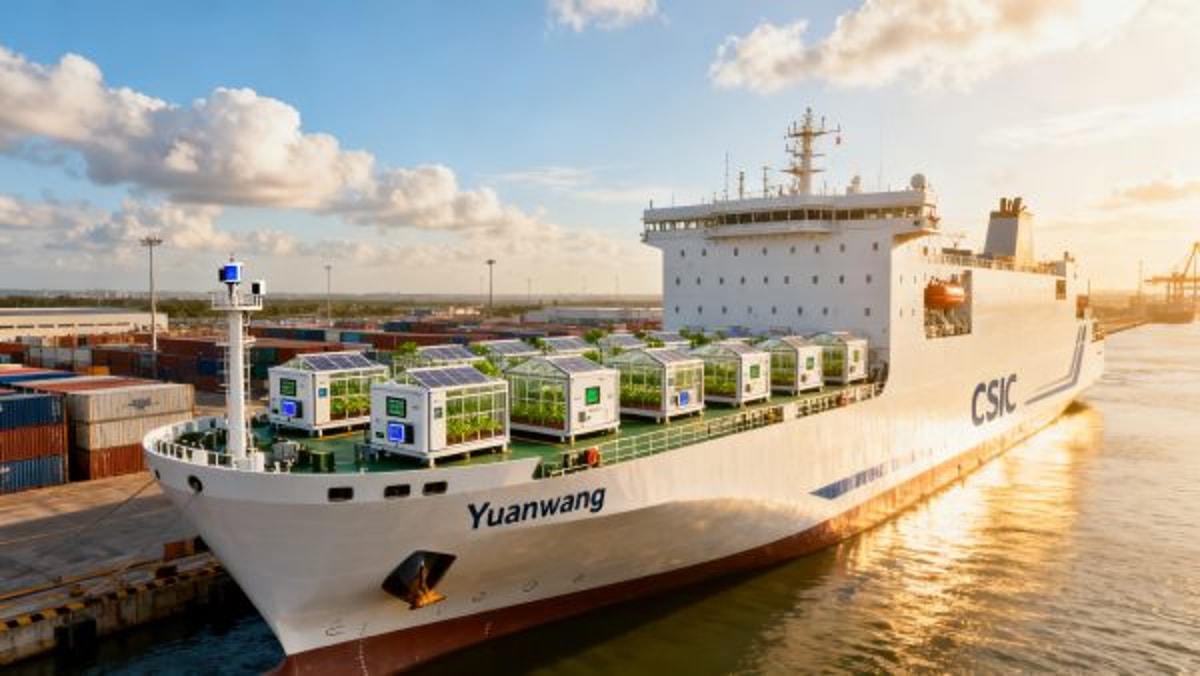
On May 3, 2026, China State Shipbuilding Corporation’s LNG-powered ‘Yuanwang’ — the world’s first 10,000-vehicle-capacity roll-on/roll-off (RoRo) vessel — was officially delivered. The ship inaugurates a dedicated Shanghai–Rotterdam–Los Angeles service for Smart Greenhouse equipment, featuring temperature- and humidity-controlled cargo holds (15–22°C), photovoltaic power interfaces, and IoT-based environmental monitoring terminals. This development is especially relevant for precision agriculture technology providers, climate-control hardware manufacturers, and global cold-chain logistics operators.
Event Overview
On May 3, 2026, the LNG-powered ‘Yuanwang’ RoRo vessel — rated for up to 10,000 vehicles — was delivered under China State Shipbuilding Corporation. Concurrently, a dedicated maritime service named the ‘Smart Greenhouse Equipment Express’ launched between Shanghai, Rotterdam, and Los Angeles. The service includes specialized cargo holds maintaining 15–22°C, onboard photovoltaic power supply interfaces, and integrated IoT environmental monitoring terminals. It is designed exclusively for high-value controlled-environment agriculture (CEA) equipment — including climate controllers and soilless cultivation modules. Bookings for this dedicated capacity are open through Q3 2026.
Impact on Specific Industry Segments
Direct Exporters of Controlled-Environment Agriculture (CEA) Equipment
These companies — such as manufacturers of greenhouse climate controllers or hydroponic/nutrient-film modules — now face a new, purpose-built transport option. Unlike standard reefer containers, this service offers stable ambient conditions (not sub-zero refrigeration), PV-ready power interfaces, and real-time environmental telemetry — all critical for sensitive electronics and calibration-sensitive devices. Impact manifests in reduced transit-related failures, lower insurance premiums for high-value shipments, and potential lead time compression for transoceanic deliveries.
Supply Chain Service Providers (Freight Forwarders & NVOCCs)
Firms specializing in agricultural tech logistics must now assess integration with this dedicated slot. The fixed temperature band (15–22°C), rather than typical refrigerated ranges, implies non-standard handling protocols and requires updated quoting tools, documentation templates, and carrier coordination workflows. Early adoption may yield competitive differentiation in serving CEA clients — but only if forwarders verify compatibility with their clients’ packaging, labeling, and pre-shipment conditioning requirements.
Global Distributors of Precision Horticulture Systems
Distributors operating across EU–US–Asia corridors — particularly those managing inventory for modular greenhouse deployments — may see improved forecast reliability. The reserved Q3 2026 capacity signals early-stage infrastructure commitment to CEA hardware trade flows. However, since the service is not yet scaled across multiple vessels or routes, impact remains limited to specific origin–destination pairs and product categories. No change to inland drayage, customs clearance, or last-mile delivery obligations is indicated.
What Stakeholders Should Monitor and Act On Now
Confirm eligibility and technical specifications before booking
Not all ‘climate-controlled’ equipment qualifies: only units requiring continuous 15–22°C ambient (not active cooling or heating during transit) and compatible with standard RoRo stowage dimensions are eligible. Shippers should request the official cargo acceptance checklist and verify IoT terminal integration requirements — e.g., whether device-level telemetry must feed into the ship’s monitoring system.
Track booking window timelines closely
Cargo slots are reserved through Q3 2026, but no public information confirms whether additional capacity will be added beyond that period or whether pricing is fixed or dynamic. Companies planning Q4 2026 or 2027 shipments should treat current availability as time-bound and begin contingency planning — including parallel quotes from conventional reefer carriers — now.
Validate alignment with regional certification and labeling rules
The route spans three regulatory jurisdictions (China, EU, US). While the vessel itself meets IMO Tier III and EU ETS compliance, shippers remain responsible for meeting local import requirements — e.g., CE marking for EU-bound units, FCC certification for US-bound electronics, and China’s CCC requirements. No indication suggests this service includes regulatory advisory support.
Editorial Perspective / Industry Observation
Observably, this initiative reflects a structural shift: maritime infrastructure is beginning to specialize not just by temperature range (e.g., frozen vs. chilled), but by end-use application — here, controlled-environment agriculture. Analysis shows this is less a fully scaled commercial service and more a pilot-scale infrastructure signal: one vessel, one route, one defined cargo profile. It does not replace existing reefer networks but introduces a vertically aligned alternative for a narrow, high-margin segment. From an industry perspective, its significance lies not in immediate volume impact, but in validating demand for application-specific maritime logistics — suggesting similar niche services may emerge for other advanced manufacturing verticals (e.g., lab-grown food bioreactors, photobioreactor systems).
Current more appropriately understood as an infrastructure signal — not yet a market-wide operational shift — it warrants attention from firms whose products sit at the intersection of precision electronics, climate sensitivity, and international deployment scalability.
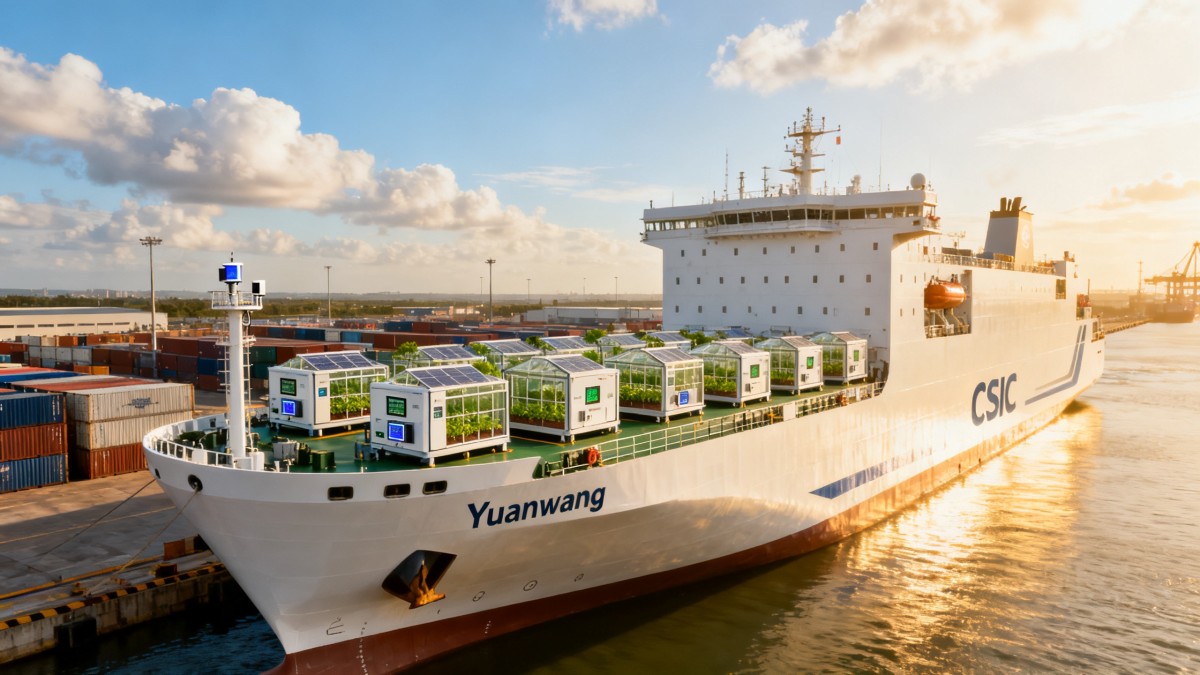
Conclusion: This delivery marks the first known instance of a RoRo vessel operationally configured for controlled-environment agriculture hardware logistics. Its relevance is concentrated, not broad: it matters most for exporters and distributors of high-value, ambient-stable climate control and soilless cultivation systems moving between Asia, Europe, and North America. For now, it functions best as a capability benchmark and early-adopter opportunity — not a wholesale replacement for conventional cold-chain options.
Information Source: Official delivery announcement by China State Shipbuilding Corporation, dated May 3, 2026. Details regarding service parameters, cargo specifications, and booking windows are drawn exclusively from that release. Ongoing observation is recommended for confirmation of fleet expansion, route extension, or tariff transparency beyond Q3 2026.
Related Intelligence
- Smart GreenhouseWorld's First 10,000-Car RoRo Delivered; Smart Greenhouse Cargo Gets Dedicated Cold-Chain SlotWorld's first 10,000-car RoRo vessel 'Yuanwang' delivers smart greenhouse cargo via dedicated cold-chain slots — optimized for precision agri-tech exports.
- Smart GreenhouseAnti bird netting wholesale failures often start at knot strengthAnti bird netting wholesale decisions often fail at knot strength. Learn how to inspect quality, reduce replacement risk, and choose suppliers that deliver safer, longer-lasting netting.
- Smart GreenhouseAgricultural shade net bulk: when shade percentage misleads buyersAgricultural shade net bulk buying is not just about shade percentage. Learn how to compare UV stability, airflow, yarn quality, and durability before you source.
The Morning Broadsheet
Daily chemical briefings, market shifts, and peer-reviewed summaries delivered to your terminal.
