

The Authority in Global Agricultural Chemistry & Bio-Resources
EU Enforces EN-14279 Drone Certification for Forestry Equipment from May 2026
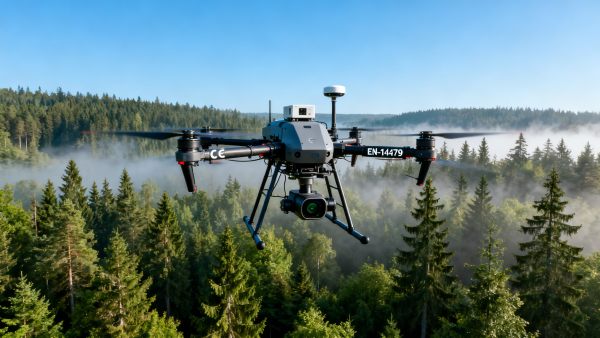
Starting 1 May 2026, the European Union will enforce mandatory compliance with EN-14279:2026 — the new harmonised standard for unmanned aircraft systems — for forestry equipment integrating drone functionality. This development directly affects manufacturers, exporters, and distributors of forest monitoring, aerial seeding, and wildfire detection systems targeting the EU market.
Event Overview
Effective 1 May 2026, the EU implements EN-14279:2026, titled Unmanned Aircraft Systems — General Requirements. The standard applies mandatorily to forestry equipment containing integrated drone modules — including those used for forest condition inspection, aerial reforestation (fly-sowing), and wildfire risk monitoring. Under this regulation, such integrated modules must undergo full-system-level conformity assessment as part of CE marking. Products lacking EN-14279:2026 certification will be denied customs clearance into the EU.
Industries Affected by Segment
Direct Exporters & OEM Manufacturers
Exporters supplying forestry equipment with embedded drone capabilities to the EU must now treat the drone module as a distinct, certifiable subsystem — not merely an ancillary feature. Impact includes extended time-to-market due to required third-party testing, revised technical documentation, and potential redesign of communication interfaces (e.g., remote identification, geofencing logic, encrypted data links).
Component Suppliers & Module Integrators
Suppliers providing flight control units, telemetry modules, or geofencing firmware for forestry drones may face upstream demand for pre-certified subassemblies. While EN-14279:2026 applies at the integrated system level, integrators are expected to verify supplier components meet underlying functional requirements (e.g., secure data transmission, real-time position reporting). This increases traceability and interface validation responsibilities.
Distribution & Aftermarket Service Providers
Distributors handling post-import assembly, software updates, or field calibration of certified forestry drones must ensure no modification invalidates the original CE declaration. Firmware patches, hardware add-ons, or configuration changes affecting autonomy, identification, or geofencing may trigger re-assessment — impacting service workflows and liability frameworks.
What Relevant Enterprises or Practitioners Should Focus On Now
Confirm scope applicability against product architecture
Assess whether your forestry equipment qualifies as an ‘integrated unmanned aircraft system’ under EN-14279:2026 — particularly if it includes autonomous navigation, remote ID broadcast, dynamic geofencing, or encrypted C2 data links. Standalone sensors without flight control or propulsion do not fall under this mandate.
Initiate engagement with EU-notified bodies ahead of Q4 2025
Certification lead times for complex UAS systems commonly exceed 4–6 months. Notified bodies experienced in both machinery (2006/42/EC) and radio equipment (2014/53/EU) domains are required for full EN-14279:2026 evaluation. Early scoping discussions help align test plans with actual system capabilities.
Review technical documentation for traceability and update protocols
EN-14279:2026 requires demonstrable traceability of all safety-critical functions — especially those related to geofence enforcement and remote ID transmission. Document versioning, change logs for firmware updates, and configuration management records must be maintained for audit purposes.
Editorial Perspective / Industry Observation
Observably, EN-14279:2026 represents a regulatory escalation from capability-based guidance to mandatory, system-level certification — shifting accountability from software-defined features to verifiable, hardware-integrated performance. Analysis shows this is less about introducing novel technical thresholds and more about formalising enforcement mechanisms previously addressed through national interpretations or voluntary schemes. From an industry perspective, the standard signals tightening convergence between aviation safety frameworks and industrial equipment regulation — particularly where autonomy and connectivity intersect. It is currently best understood as a binding compliance milestone, not merely a policy signal; however, implementation details (e.g., transitional arrangements for legacy stock, interpretation of ‘forestry equipment’ boundaries) remain subject to official EU Commission guidance pending publication.
Conclusion: EN-14279:2026 establishes a clear, non-negotiable market access requirement for forestry-grade drone systems entering the EU from May 2026. Its significance lies not in technological novelty, but in its enforceable integration of aviation-grade assurance into industrial equipment certification. For stakeholders, it is more appropriately understood as a procedural inflection point — requiring alignment across R&D, compliance, supply chain, and post-market support — rather than a standalone product development challenge.
Source: Official adoption notice of EN-14279:2026 published in the EU Official Journal (OJ C-series); referenced regulatory framework: Regulation (EU) 2018/1139 and Delegated Regulation (EU) 2019/947. Pending items for continued observation include formal Commission guidance on transitional provisions and clarification of conformity routes for hybrid forestry-machinery/UAS platforms.
Related Intelligence
- Forestry EquipmentEU Enforces EN-14279 Drone Certification for Forestry Equipment from May 2026EN-14279 drone certification is mandatory for EU forestry equipment from May 2026 — ensure compliance now to avoid customs delays and market access loss.
- Forestry EquipmentBIS Mandates Separate Certification for Drone & AI Modules in Forestry EquipmentBIS mandates separate certification for drone & AI modules in forestry equipment—key for Chinese exporters targeting India. Act now to avoid license invalidation by 30 Sep 2026.
- Forestry EquipmentBIS Mandates Separate Certification for Drone & AI Modules in Forestry EquipmentBIS mandates separate certification for drone & AI modules in forestry equipment—key for Chinese exporters targeting India. Act now to avoid license invalidation by 30 Sep 2026.
The Morning Broadsheet
Daily chemical briefings, market shifts, and peer-reviewed summaries delivered to your terminal.
